
PROCESS GUIDE
Foundry & Melting Fume
Furnaces release hot fume in bursts at charging and tapping. Cool it first, then filter it in a baghouse, and place the furnace hood so charging and crane work stay clear.
Send your duty, get a proposal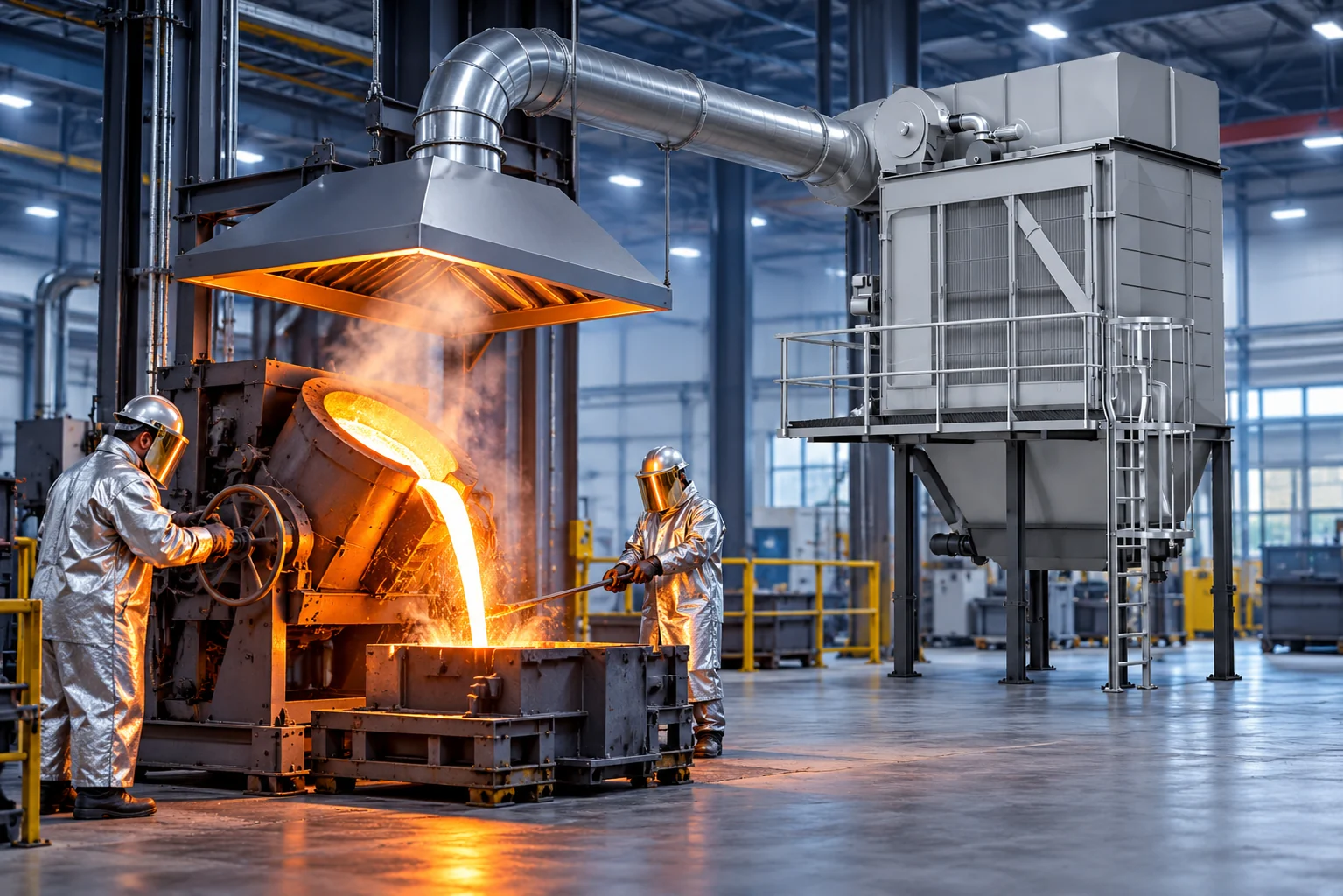
What is released
Melting fume is fine, hot metal-oxide particulate whose concentration jumps at charging and tapping; pouring and cooling fume is spread along long lines.
Gas hotter than the media rating burns bags, so cool it first; cooler gas also has less volume, so the collector can be smaller.
Choosing the capture method
| Capture method | Suits | Key point |
|---|---|---|
| Swing or movable furnace hood | Induction and arc furnaces | Swing clear for charging and tapping; cover the furnace while melting |
| Side hood | Limited space around the furnace | Close to the furnace mouth, clear of the crane path |
| Sectional overhead extraction | Pouring and cooling lines | Open only the section being poured |
Sizing the bag area
With 18,000 m³/h actual airflow at the collector after cooling and a filtration velocity of 0.80 m/min, bag area A = Q / (60 × v) = 18,000 / (60 × 0.80) = 375 m². Then choose the model for dust loading and cleaning method.
Recommended series
- SMB reverse-air trolley baghouse
- Hot gas from aluminium and foundry work, continuous cleaning, 210–2,310 m².
- SIB industrial baghouse
- 4 m and 6 m bags for high airflow and high loading.
- SMC flat-bag collector
- For limited headroom; bags change from the side.
Safety and maintenance
- Gas temperature swings widely; fit temperature monitoring and over-temperature protection.
- The furnace mouth sees splash and radiant heat; position hoods so charging, tapping and crane work stay safe.
- Dust from aluminium and magnesium melting and fettling is combustible; assess it first.
What to tell us for selection
- Furnace type, capacity and number
- Heats per day
- Alloy (grey iron, ductile iron, steel, aluminium)
- Space around the furnace and crane position
- Existing collectors and emission requirements