
BY CONTAMINANT
Hot Process Fume
Fume from melting, pouring, heat treatment and hot cutting is hot and rises fast. Size the airflow at the real temperature, then decide on cooling and filtration.
Send your process details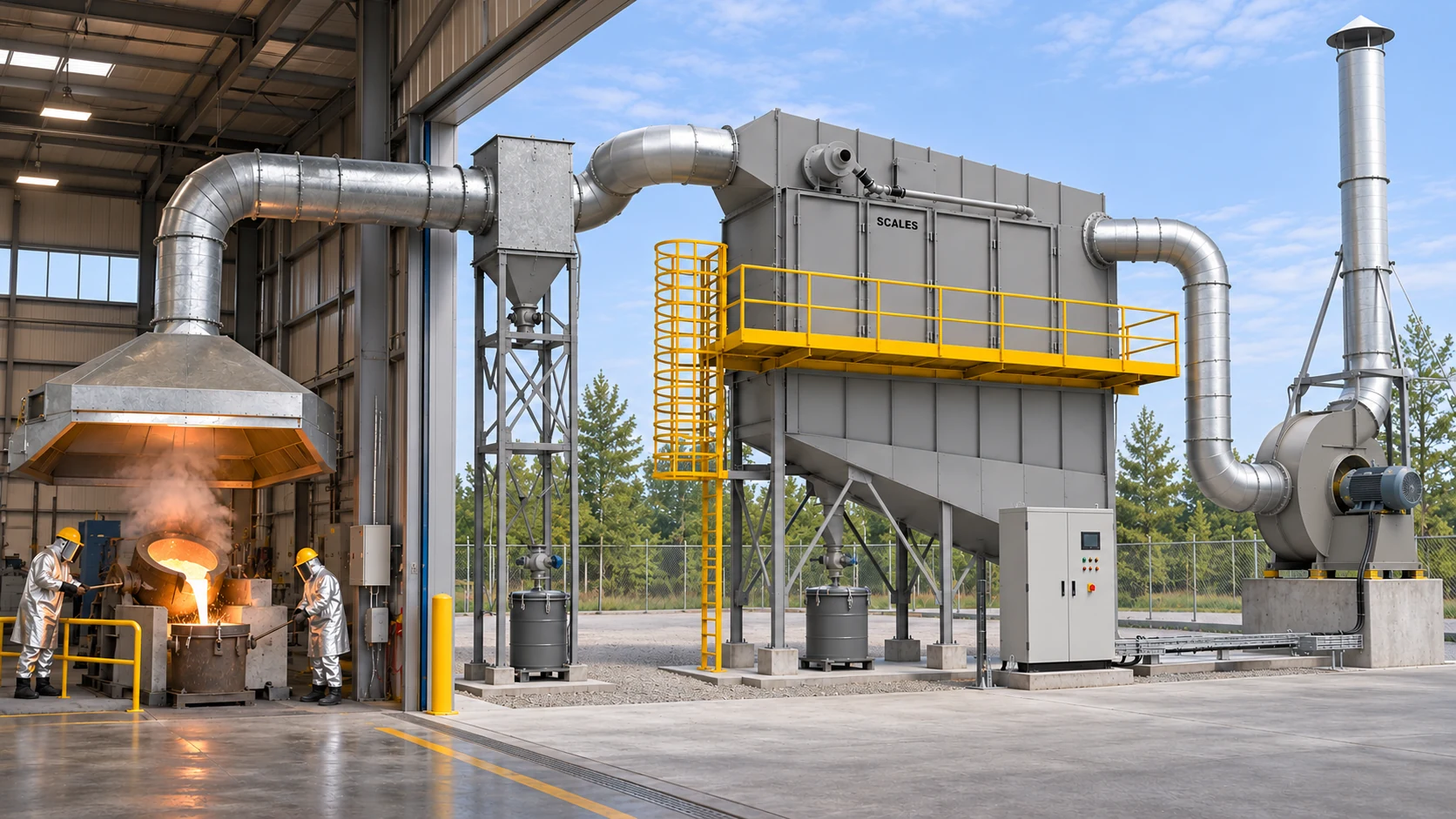
01
Where it comes from
- Electric and induction furnace melting and tapping
- Pouring and casting cooling
- Heat-treatment furnaces and quenching
- Hot forging and hot cutting
02
Capture along the plume
Hot fume rises on its own, so hoods follow the plume. Furnace mouths use furnace-mounted or side hoods that leave room for charging, tapping and cranes; quench tanks use rim slot extraction close to the oil surface; pouring lines use travelling or side hoods. A hood set too high lets cross-drafts scatter the fume.
03
Temperature and airflow
Gas expands when heated, so the same mass of air takes more volume: Q₂ = Q₁ × T₂ / T₁ (absolute temperature). For example, 1,000 m³/h of air at 20 °C becomes about 1,136 m³/h at 60 °C. Equipment is sized for the airflow at the actual temperature.
04
Cooling and filtration
| Situation | What we do |
|---|---|
| Gas hotter than the media allows | Dilute with cool air, cool along the duct or with a heat exchanger, then filter in a baghouse (SIB, SMB, SMC) |
| Sparks or dross present | Add spark arrest or a pre-separator ahead of the collector |
| Oily or humid fume | Scrub and cool first in an SVT venturi scrubber |
| How far to cool | Stay above the dew point to avoid condensation, blinded bags and corrosion |
05
Tell us when you enquire
- Process and materials
- Fume temperature at the source, in the duct and at the collector inlet
- Production cycle, including peaks at charging and tapping
- Photos of existing hoods and ducts
NEXT STEP