
PROCESS GUIDE
Heat Treatment & Industrial Oil Smoke
Quenching, cold heading, die casting and extrusion heat oil into sticky, fine smoke that builds up in ducts. Use washable electrostatic cells, or cool with a scrubber first and then collect electrostatically.
Send your duty, get a proposal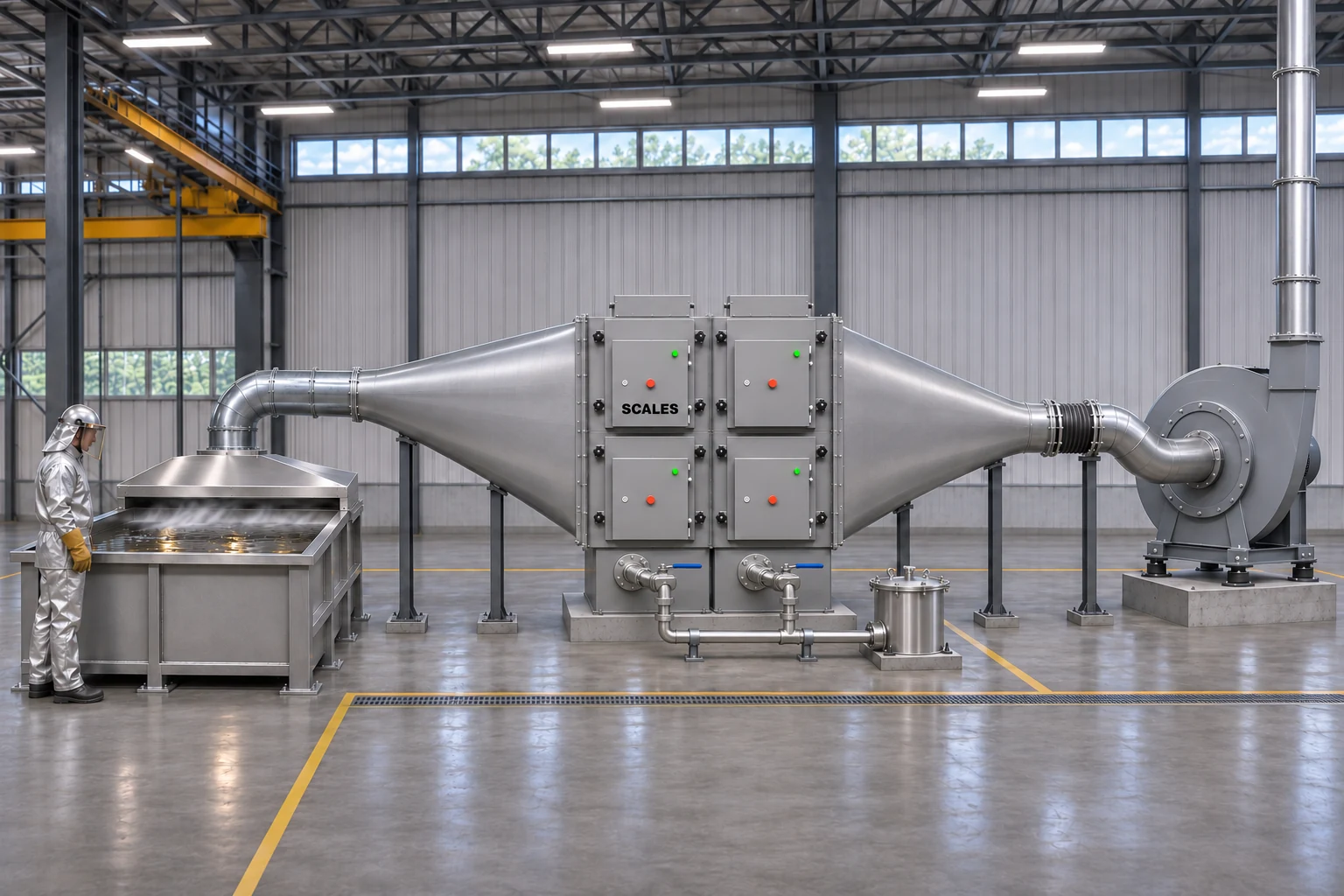
What is released
Smoke bursts out when a hot part enters the quench tank; lubricants in cold heading and extrusion are atomised at speed; release agent flashes into white mist on a hot die.
Oil smoke is finer and stickier than machining mist and quickly blinds ordinary media.
Choosing the capture method
| Treatment | Suits | Key point |
|---|---|---|
| Electrostatic | Continuous smoke from quenching, cold heading and die casting | Low resistance; wash the cells on schedule |
| Scrubber + electrostatic | Hot smoke with water vapour | Cool and remove large droplets in a scrubber, then collect electrostatically |
| Wet scrubbing | Quench smoke and hot-forging graphite smoke | Scrubs and cools at the same time |
How temperature changes airflow
1,000 m³/h of air at 20 °C becomes Q₂ = Q₁ × T₂/T₁ = 1,000 × 333.15/293.15 ≈ 1,136 m³/h at 60 °C and the same pressure. Size equipment for the airflow at the actual temperature.
Recommended series
- SEM electrostatic mist collector
- Modular, 2,500–50,000 m³/h at about 100 Pa, for central systems.
- SEA integrated electrostatic unit
- For a single quench tank or cold header.
- SVT venturi wet scrubber
- Scrubbing and cooling of quench and hot-forging smoke.
Safety and maintenance
- Clean oil from ducts and units regularly to prevent oil fires.
- Electrostatic units remove particles only; add activated carbon where odour or gases must be treated.
- Acid mist from pickling and plating is outside the scope of this equipment.
What to tell us for selection
- Process (quenching, cold heading, die casting, extrusion)
- Oil or release agent type
- Smoke temperature and whether there is water vapour
- Number and layout of machines
- Emission requirements