
TECHNICAL KNOWLEDGE
Choosing Between Cartridge and Baghouse Dust Collectors
Cartridges use pleated media, packing a large filter area into a small housing, and suit fine dust from welding, cutting and grinding; baghouses suit heavy loads, higher temperatures and continuous duty.
Request a Technical Assessment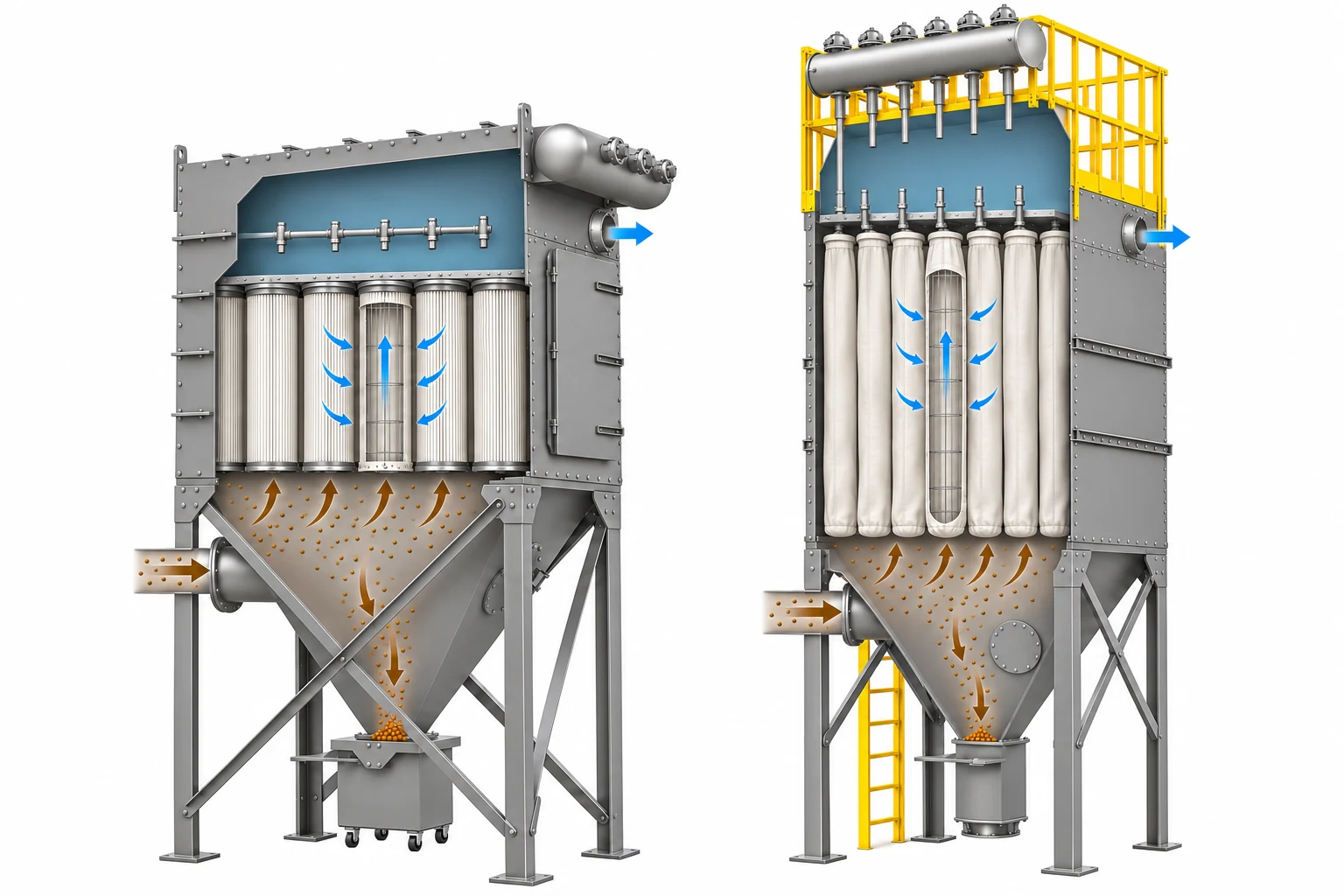
The differences
| Aspect | Cartridge collector | Baghouse |
|---|---|---|
| Filter area | Pleated media; more area per volume | Area comes from bag number and length |
| Dust | Fine, dry fume and dust | Heavy, mixed sizes, abrasive |
| Temperature | Mostly ambient | Higher temperatures with heat-resistant bags |
| Filter changes | Whole cartridges, quick | More bags; needs access space |
| SCALES series | SCU, SCW, SLF, SVF, SHF | SIB, SMC, SMB |
Sizing the filter area
Filter area A = Q ÷ (60 × v), where Q is the actual airflow into the collector (m³/h) and v is the filtration velocity (m/min). At 7,200 m³/h and 0.80 m/min, the area is 7,200 ÷ (60 × 0.80) = 150 m².
Choose the filtration velocity for the dust and media: lower for fine particles such as welding fume, which also extends filter life. SCALES lists SCU airflow for 0.85–1.2 m/min.
How to choose
- Welding, laser and plasma cutting, grinding: cartridges.
- Foundry shake-out, sand handling, building materials, powder charging and packing: baghouse.
- Furnace fume: cool first, then a baghouse.
- Low headroom: horizontal-cartridge SHF or flat-bag SMC.