
PROCESS GUIDE
Composite Cutting & Sanding
Sawing, trimming, drilling and sanding glass-fibre and carbon-fibre composites release very fine fibre dust that irritates the skin; carbon fibre also conducts electricity. Capture it at the tool, and put large parts in a sanding room.
Send your duty, get a proposal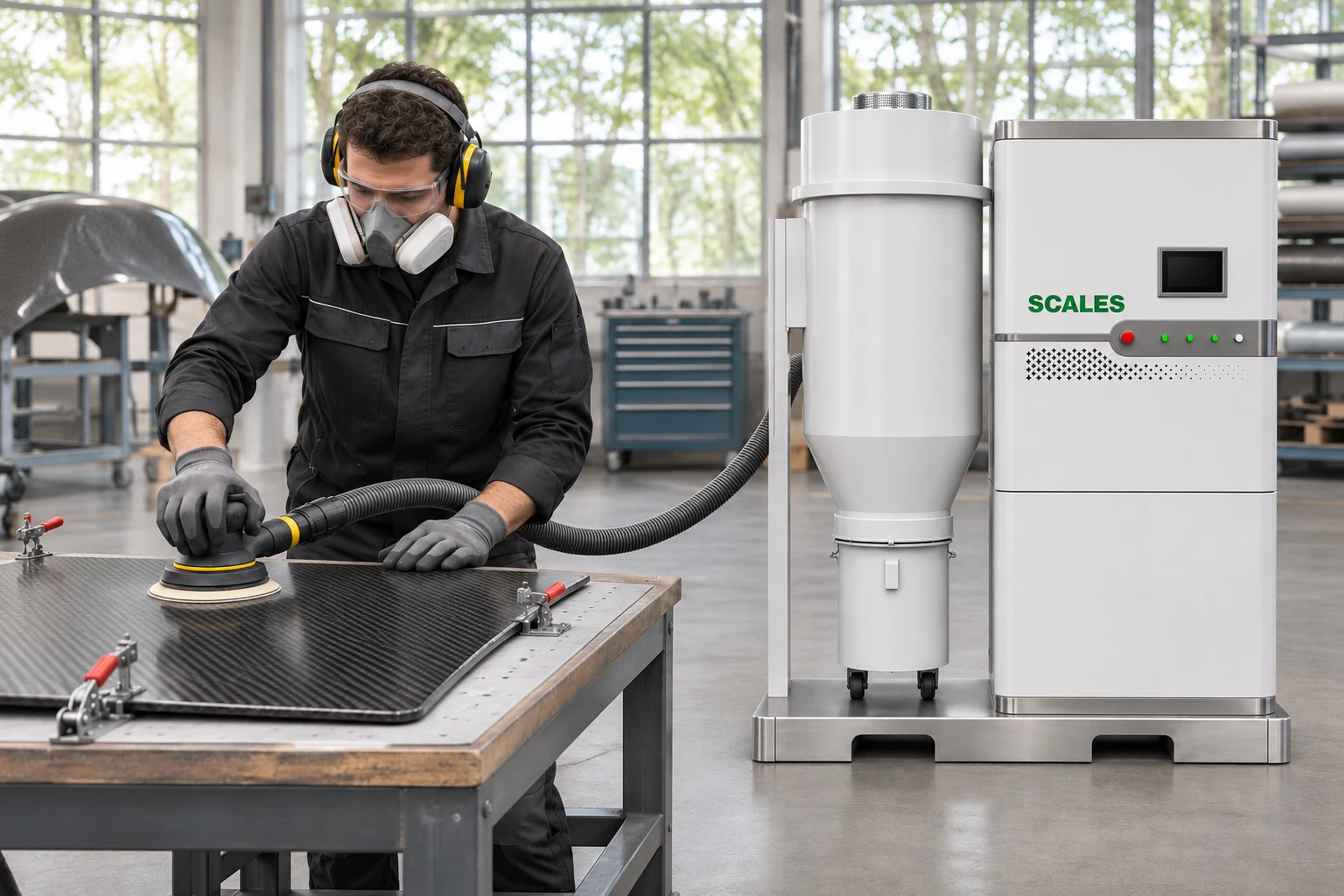
What is released
Composite dust is fine and light and stays airborne; once it settles on equipment and people it is hard to clean, and carbon-fibre dust short-circuits electrical cabinets.
Grinding large parts such as wind blades and hulls produces heavy dust, so tool extraction and a sanding room are used together.
Choosing the capture method
| Capture method | Suits | Key point |
|---|---|---|
| On-tool extraction | Hand sanders, trimmers and drills | High vacuum and small bore; keep hoses short with few bends |
| Machine-port extraction | CNC routing and dry cutting | One connection per machine |
| Sanding room | Blades, hulls and large body parts | Room airflow plus tool extraction |
Sizing a branch
A trimming branch carrying 360 m³/h at 20 m/s needs D = √(4Q / (3600 × π × v)) = √(4 × 360 / (3600 × π × 20)) ≈ 0.080 m, so use 80 mm.
Recommended series
- SVB-T high-vacuum unit
- A few tools nearby; optional H13 or H14 final stage.
- SVB high-vacuum baghouse
- Central extraction for many tools and machines.
- SCW workroom cartridge collector
- Sanding rooms for large parts.
Safety and maintenance
- Carbon-fibre dust is conductive: plan extraction and electrical protection together.
- Gases from resin curing and adhesives are treated separately.
- Resin dust is combustible; assess it first.
What to tell us for selection
- Material (glass fibre, carbon fibre, aramid)
- Processes and tools
- Part size
- Number of tools and stations
- Electrical equipment in the area