
PROCESS GUIDE
Abrasive Blasting & Shot Blasting
Blasting produces heavy, abrasive dust mixed with rust, scale, old coatings and broken media. Use a pre-separator to remove coarse particles, then filter with cartridges or bags.
Send your duty, get a proposal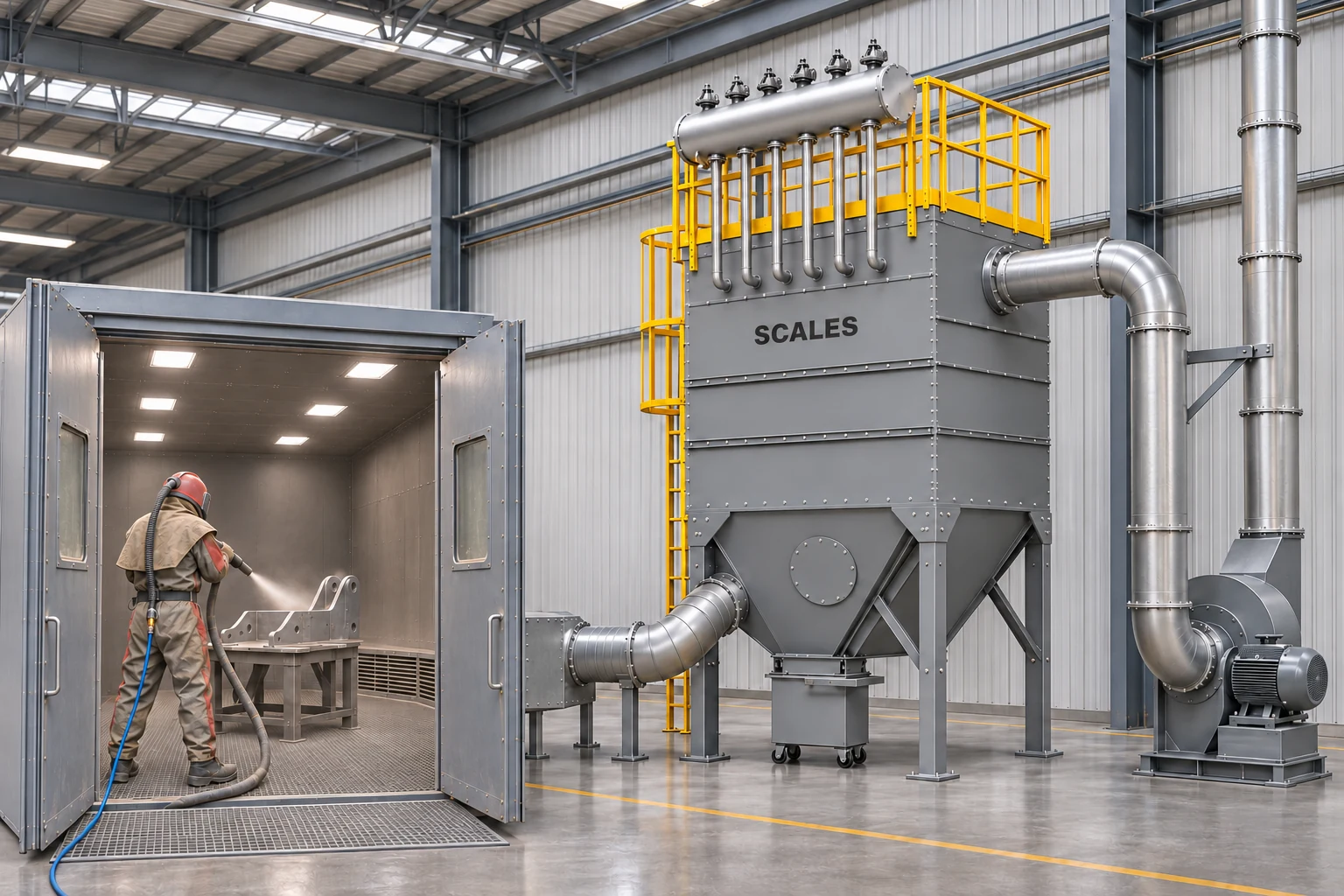
What is released
A shot blaster is enclosed, so dust is extracted straight from its connection; in a blast room people work inside, and steady airflow must carry dust away from the operator.
Old coatings in the dust may contain heavy metals, and dust from blasting aluminium is combustible.
Choosing the capture method
| Capture method | Suits | Key point |
|---|---|---|
| Direct connection to the shot blaster | Through-feed, hanger and tumble blasters | Pre-separator before the inlet to reduce wear |
| Whole-room blast extraction | Manual blast rooms | Balance supply and exhaust so air flows from behind the operator to the part |
| Blast cabinet | Small parts | Cabinet connects to a small collector |
Blast-room air balance
With 5,000 m³/h supply, 800 m³/h of nozzle air and 600 m³/h drawn in through door gaps, exhaust = 5,000 + 800 + 600 = 6,400 m³/h. Exhausting more than is supplied keeps the room under slight negative pressure so dust does not leak out.
Recommended series
- SLF and SVF central cartridge collectors
- Fine dust from shot blasters and blast rooms.
- SIB and SMC baghouses
- Large, continuously running shot-blast lines with heavy dust.
- SVT venturi wet scrubber
- Combustible dust from blasting aluminium parts or aluminium spraying.
Safety and maintenance
- Dust from blasting aluminium is combustible: design dry systems for explosion protection, or use wet collection.
- Elbows and inlets are built for wear.
- Where old coatings contain lead or chromium, protect staff during filter changes and dust removal.
What to tell us for selection
- Blaster or room type and size
- Media (steel shot, steel grit, silica, alumina)
- Part material and surface coating
- Whether aluminium parts are blasted
- Existing supply and exhaust