
TECHNICAL KNOWLEDGE
Dust Extraction for Shot Blasting Machines and Blast Rooms
A shot blaster is enclosed, so dust is extracted straight from its connection; in a blast room people work inside, and the airflow must run from behind the operator towards the part. Both use a pre-separator for coarse particles before cartridges or bags.
Request a Technical Assessment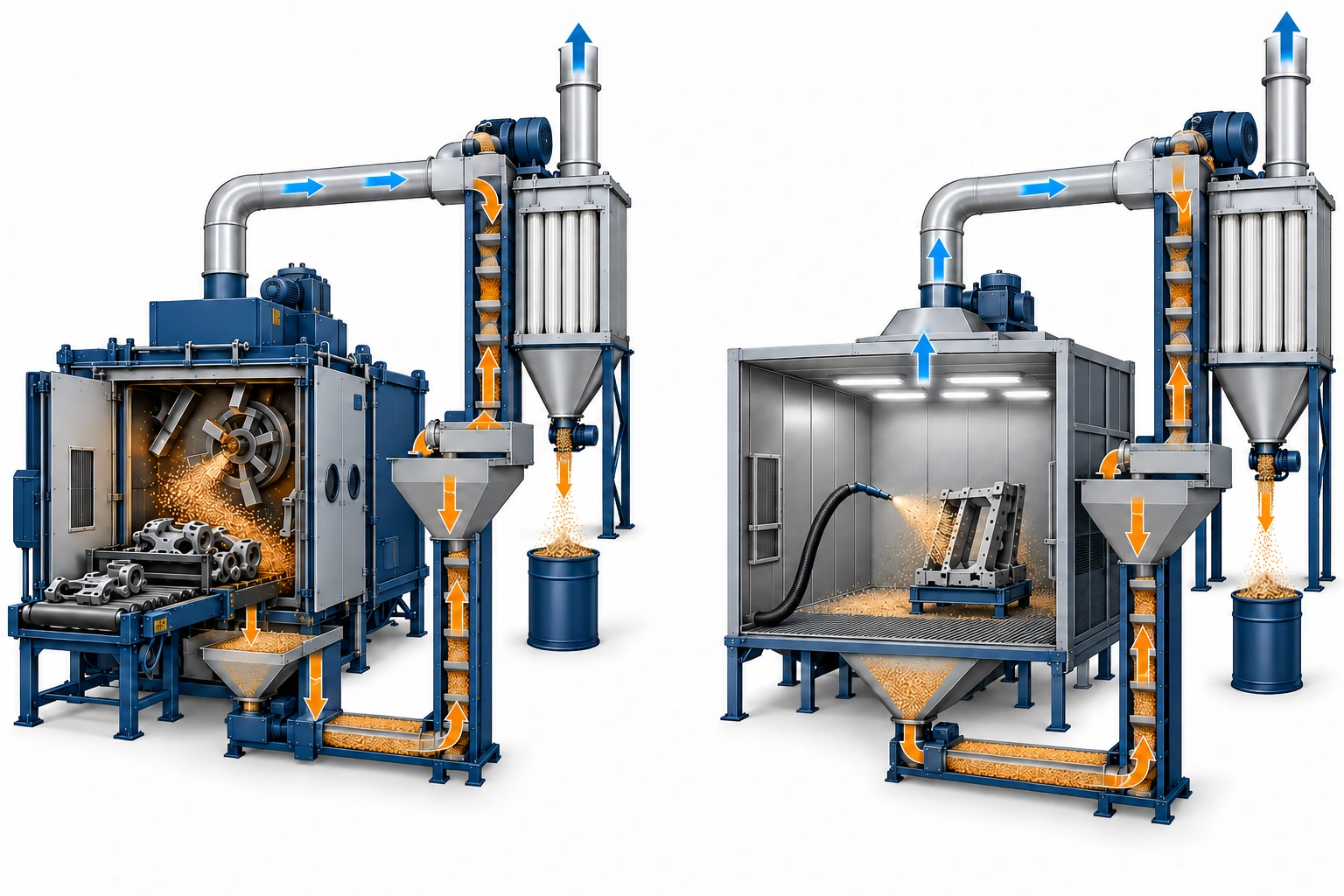
Shot blasters
- Extract from the cabinet connection and keep the inlet and outlet under slight negative pressure.
- A pre-separator (labyrinth or cyclone) at the inlet reduces wear.
- Elbows and inlets are built for wear.
Blast rooms
Balance supply and exhaust, exhausting a little more so the room stays under slight negative pressure. For example, with 5,000 m³/h supply, 800 m³/h of nozzle air and 600 m³/h drawn in at door gaps, exhaust = 5,000 + 800 + 600 = 6,400 m³/h. Air flows from behind the operator towards the part, so dust never passes the operator's face.
Points to watch
- Dust from blasting aluminium is combustible: design dry systems for explosion protection, or use wet collection.
- Old coatings may contain lead or chromium: protect staff during filter changes and emptying.
- Separate abrasive recovery from dust collection so recycled media carries little dust.
- Suggested series: SLF and SVF cartridges, SIB and SMC baghouses, SVT wet scrubber for aluminium dust.