
PROCESS GUIDE
Welding Fume
Most welding-fume particles are below 1 µm and rise with the heat, straight through the welder's breathing zone. The key is to capture fume beside the arc before it rises.
Send your duty, get a proposal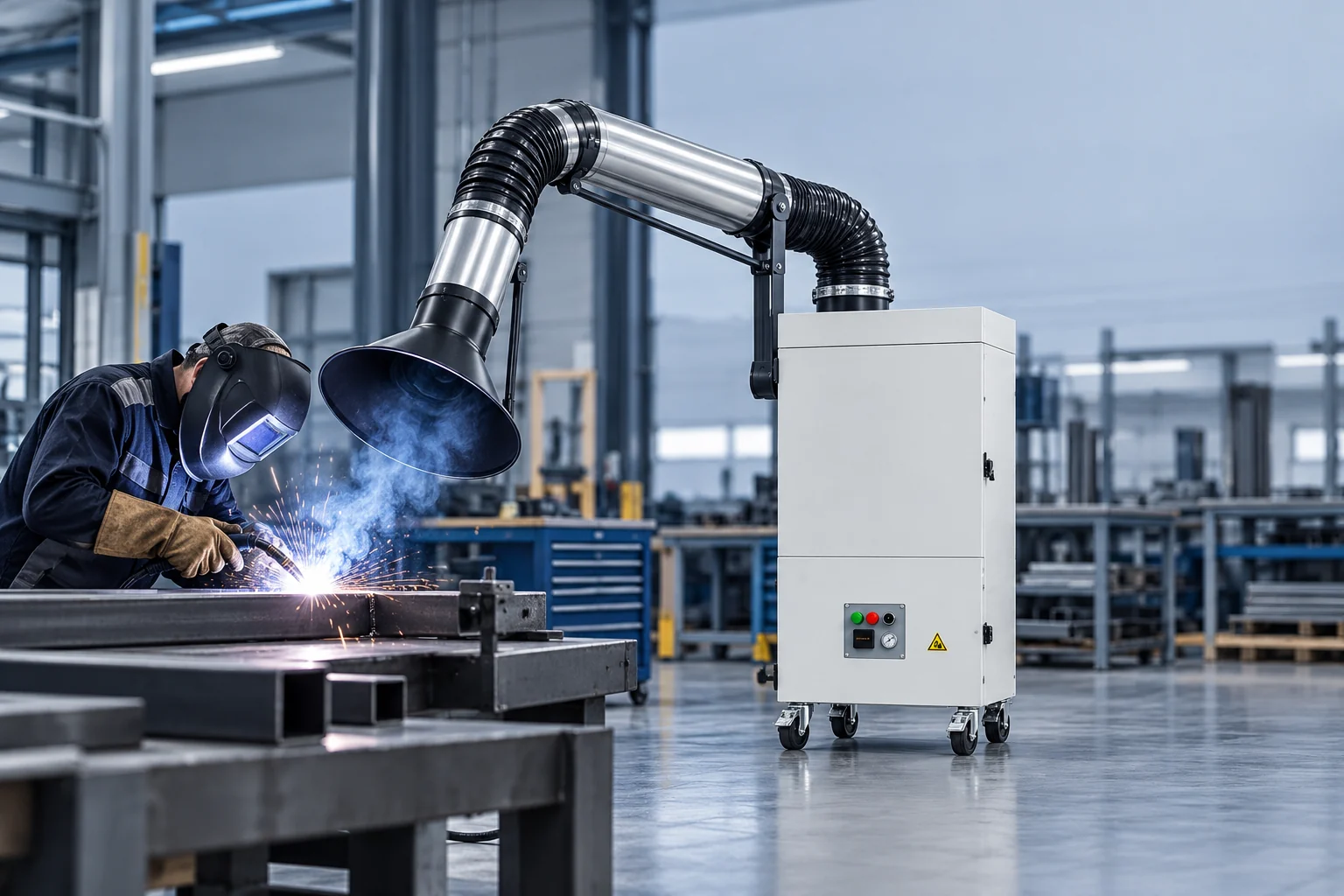
What is released
Metal and filler evaporate in the arc and condense into very fine particles. The volume is small but continuous, and once fume spreads it is hard to recover. Stainless-steel fume also contains chromium and nickel compounds.
The further the hood is from the arc, the more air it needs: double the distance and airflow rises roughly fourfold. Capturing close to the arc is the cheapest design.
Choosing the capture method
| Capture method | Suits | Key point |
|---|---|---|
| Extraction arm | Manual welding where the station moves | Keep the hood beside and above the arc and move it with the weld |
| Booth or cell enclosure | Robotic and fixed-station welding | Enclose and extract; the smaller the openings, the less air; add a canopy on top |
| On-torch extraction | Long welds and large parts out of an arm's reach | High vacuum and low airflow, set so the shielding gas is not disturbed |
Estimating airflow
A booth opening of 0.60 m × 0.40 m gives A = 0.24 m². At 0.50 m/s through the opening, Q = 3600 × A × v = 3600 × 0.24 × 0.50 = 432 m³/h. On a real project, confirm against weld positions, loading and operator positions.
Recommended series
- SCS mobile fume extractor
- 3 m arm, single SCS-10 or twin SCS-20; wheel it to the station and start.
- SCU integrated cartridge collector
- One per booth or robot cell; connect power and compressed air and it runs.
- SLF, SVF, SHF central cartridge collectors
- Body-welding lines and several booths share one duct network and one collector.
- SVB-T high-vacuum unit
- Connects to on-torch extraction for long welds on large parts.
Safety and maintenance
- Welding throws sparks: fit a spark arrestor or pre-separator at the inlet of central systems and do not store dust in the hopper.
- Fume from stainless and galvanised work is complex; do not return filtered air into the breathing zone.
- Dust from welding and grinding aluminium and magnesium is combustible; assess it first.
What to tell us for selection
- Welding process (MIG/MAG, TIG, stick)
- Material (carbon steel, stainless, aluminium, galvanised)
- Number of stations and how many weld at once
- Part size and whether stations move
- Shop layout; discharge outdoors or back to the hall