
TECHNICAL KNOWLEDGE
Why Welding Fume Should Be Captured at Source
Most welding-fume particles are below 1 µm and rise with the heat straight to the welder's face. Capturing fume beside the arc works far better than ventilating the whole hall, and uses less energy.
Request a Technical Assessment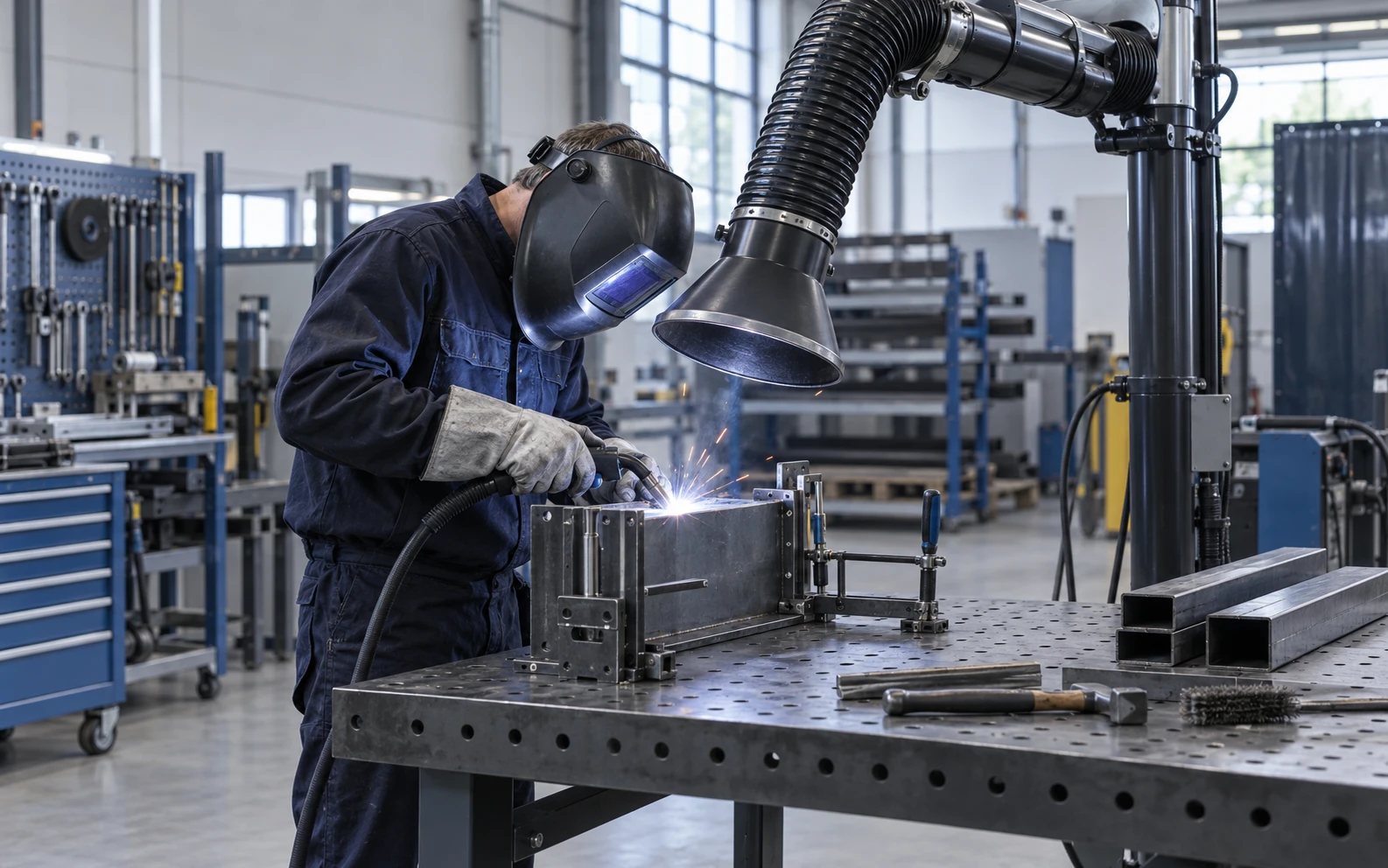
Why capture at source
- Once fume spreads, it dilutes but covers a larger area, and recovering it takes many times the airflow.
- Doubling the hood distance roughly quadruples the airflow needed. Staying close is the cheapest design.
- General ventilation dilutes what remains; it cannot replace source capture, but make-up air is still needed.
Three ways to capture
- Extraction arm: manual welding, with the welder moving the hood along the seam. SCALES SCS has a 3 m arm.
- Booth or cell enclosure: fixed stations and robots; enclose and extract, and the smaller the openings, the less air is needed.
- On-torch extraction: large parts and long welds out of an arm's reach; set it so the shielding gas is not disturbed.
Keep it working
Move the arm with the weld and keep the hood beside and above the arc; a simple sketch at the station works better than verbal reminders. Check pressure drop and cleaning regularly; if a hood loses suction, check dampers, ducts and cartridges first. Fume from stainless and galvanised work is complex, so do not return filtered air into the breathing zone.