
PROCESS GUIDE
Laser & Plasma Cutting
Cutting fume travels downward and gathers under the table. Zoned extraction opens only the zone under the cutting head, saving most of the airflow.
Send your duty, get a proposal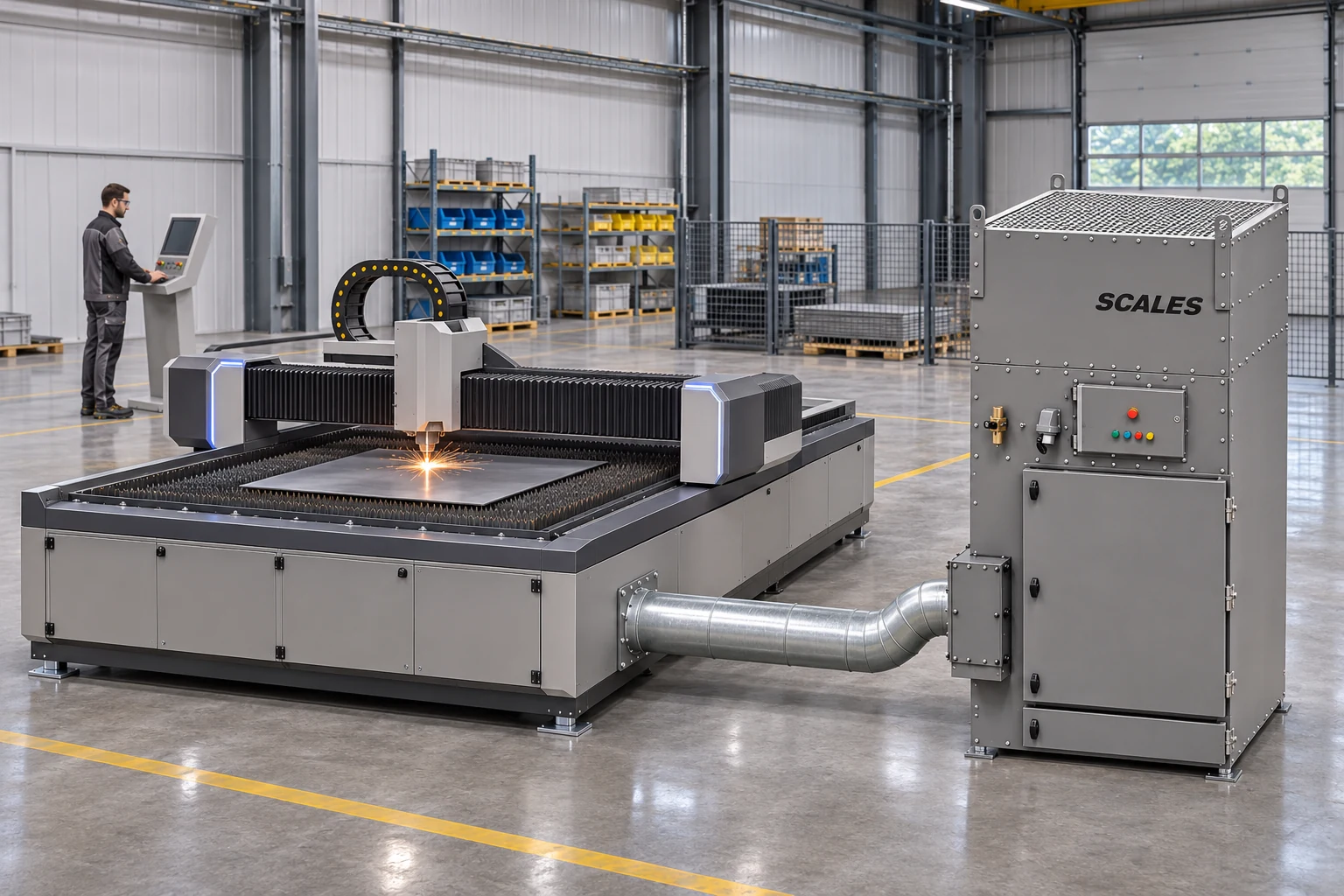
What is released
Laser fume is very fine and increases with plate thickness and power. Plasma and flame cutting produce heavy fume and many sparks, and hot particles fall into the ducts.
Extracting a whole large table at once uses a lot of air and works poorly; zoning concentrates the airflow under the cut.
Choosing the capture method
| Capture method | Suits | Key point |
|---|---|---|
| Zoned downdraft | Laser and plasma tables | Open zone dampers with the cutting head; two zones open when it crosses |
| Whole-table downdraft | Small tables | Simple and reliable for small tables and light fume |
| Enclosed cutting machine | High-power lasers | Built-in enclosure connects straight to the collector |
Estimating airflow
Each zone opening is 1.20 m × 0.90 m = 1.08 m². At 0.50 m/s, one zone needs Q = 3600 × 1.08 × 0.50 = 1,944 m³/h. When the head crosses zones, two are open, so size for 3,888 m³/h.
Recommended series
- SCU integrated cartridge collector
- One per cutting machine, four sizes SCU-4 to SCU-12; plasma cutting adds a spark-arrestor inlet.
- SHF and SVF central cartridge collectors
- Several cutting machines share one system.
- SLF long cartridge collector
- High-airflow systems for large cutting halls and thick plate.
Safety and maintenance
- Plasma and flame cutting throw many sparks: stop them at the inlet and use flame-retardant media.
- Empty the slag trays under the table regularly so hot slag and dust do not build up.
- Aluminium and titanium cutting dust is combustible; assess it first.
What to tell us for selection
- Cutting process and power
- Table size and number of zones
- Plate material and thickness
- Number of machines and how many cut at once
- Whether zone dampers are already fitted