
TECHNICAL KNOWLEDGE
Designing Zoned Extraction for Laser Cutting Tables
A laser table is divided into zones along its length, and only the damper under the cutting head opens, concentrating the airflow under the cut and needing far less air than extracting the whole table.
Request a Technical Assessment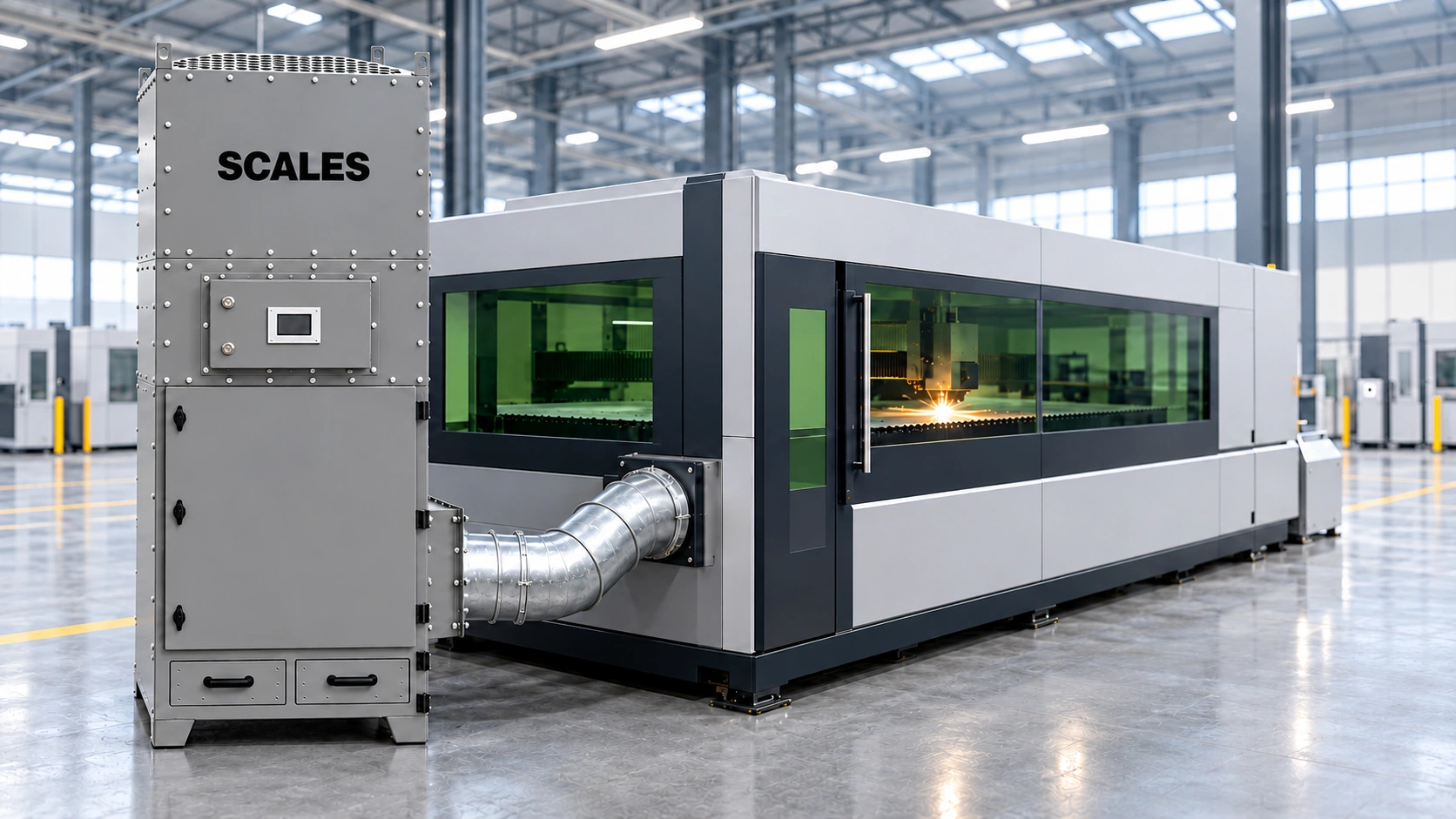
How zoning works
- Each zone has its own damper, opened and closed automatically by cutting-head position.
- When the head crosses a zone boundary, two zones open, so size for both.
- Seal the table plenum; partly covered sheets let air leak in, so allow a margin.
A worked example
Zone 1 has a 0.18 m² opening at 3 m/s; zone 2 has 0.12 m² at 2.5 m/s. Zone 1 alone: Q = 3600 × 0.18 × 3 = 1,944 m³/h. Both zones: Q = 3600 × (0.18 × 3 + 0.12 × 2.5) = 3,024 m³/h. Size the collector for 3,024 m³/h plus a leakage margin.
Sparks and slag
Cutting drops sparks and hot slag into the plenum, so empty the slag trays regularly; fit a spark arrestor or pre-separator at the inlet and use flame-retardant media. One cutting machine usually has one SCU unit (SCU-4 to SCU-12); several machines can share an SHF or SVF central system.