
BY CONTAMINANT
Welding & Cutting Fume
Most welding fume particles are smaller than 1 micron and rise with the hot plume straight into the welder’s breathing zone. The key is to capture the fume close to the weld.
Send your process details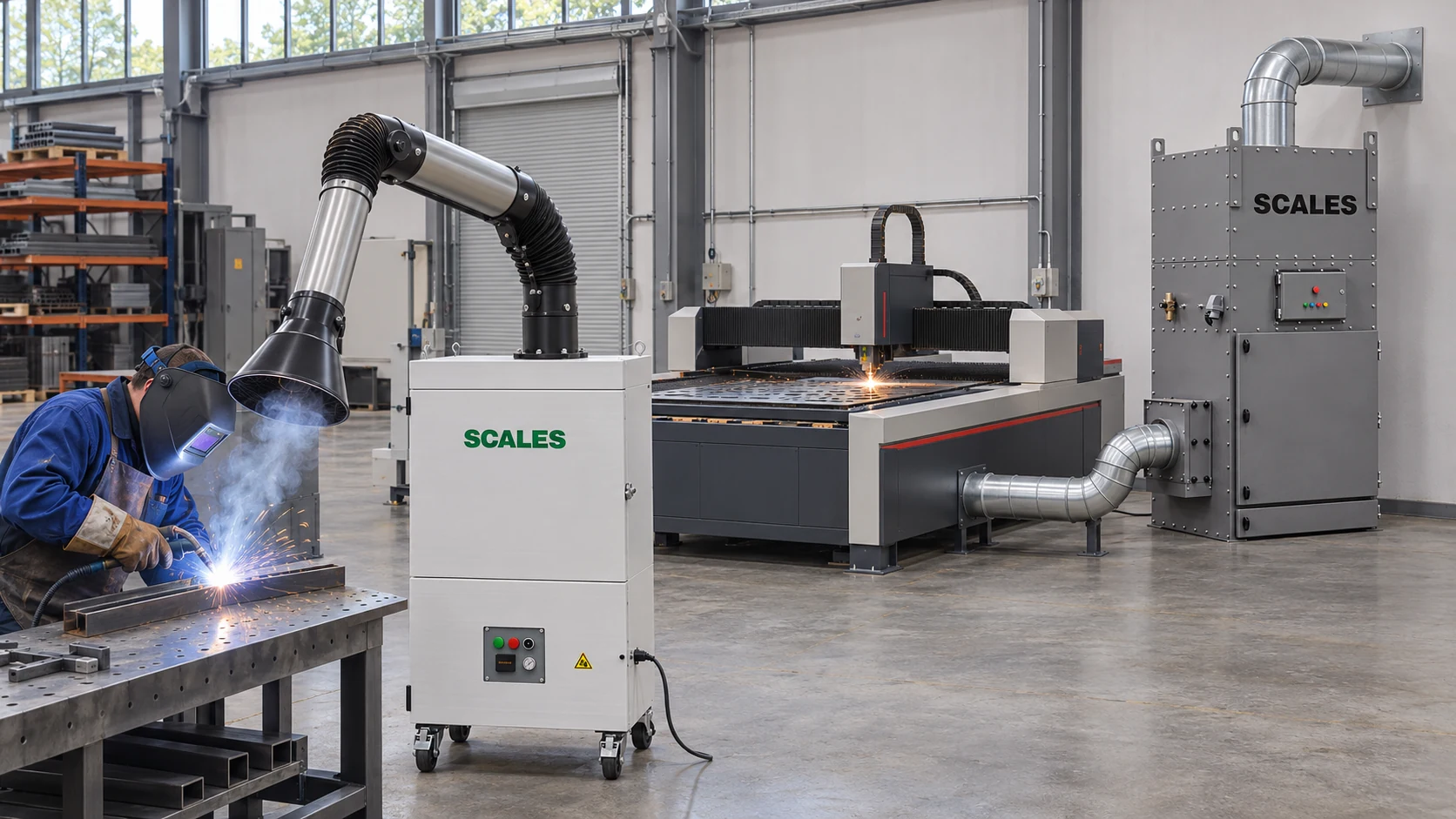
What the fume is
In welding, metal evaporates at high temperature and condenses into very fine particles. Their make-up depends on base metal, consumable and coating: mainly iron oxide for carbon steel, chromium and nickel for stainless, zinc oxide for galvanised sheet. Laser and plasma cutting fume is just as fine and also carries sparks and dross.
Capture by type of work
| Work | Capture | Series |
|---|---|---|
| Scattered stations, moving weld | Mobile extraction arm kept close to the weld | SCS mobile welding fume collector |
| Fixed stations, several benches | Arms or side hoods on a central duct system | SCU, SVF, SHF, SLF |
| Robotic welding cells | Enclosure with top or side extraction | SCU, SVF, SLF |
| Fume-extraction torches | Extraction at the torch | SVB-T integrated high-vacuum collector |
| Laser and plasma tables | Zoned downdraft that follows the cutting head | SCU, SVF, SHF, SLF |
Airflow and filtration
Airflow comes from the hood type and capture velocity; the fan is then chosen for the duct resistance. Welding fume is very fine, so membrane-coated cartridges with automatic pulse cleaning work best. Where cutting throws many sparks, add spark arrest or pre-separation before the collector.
Protecting welders
Capture at source is the most effective control. Alongside the equipment, provide suitable personal protection and check hood position and pressure drop regularly. Stainless and galvanised welding fume is more hazardous and needs tighter capture.
Tell us when you enquire
- Welding process and materials: base metal, consumable, coating
- Number of benches or robots and how many weld at once
- Workpiece size and whether a crane is used
- Shop layout and photos
NEXT STEP