
BY CONTAMINANT
Oil Mist & Oil Smoke
Machining creates oil mist; quenching, cold heading and die casting create oil smoke. Smoke is finer and stickier and needs a different approach.
Send your process details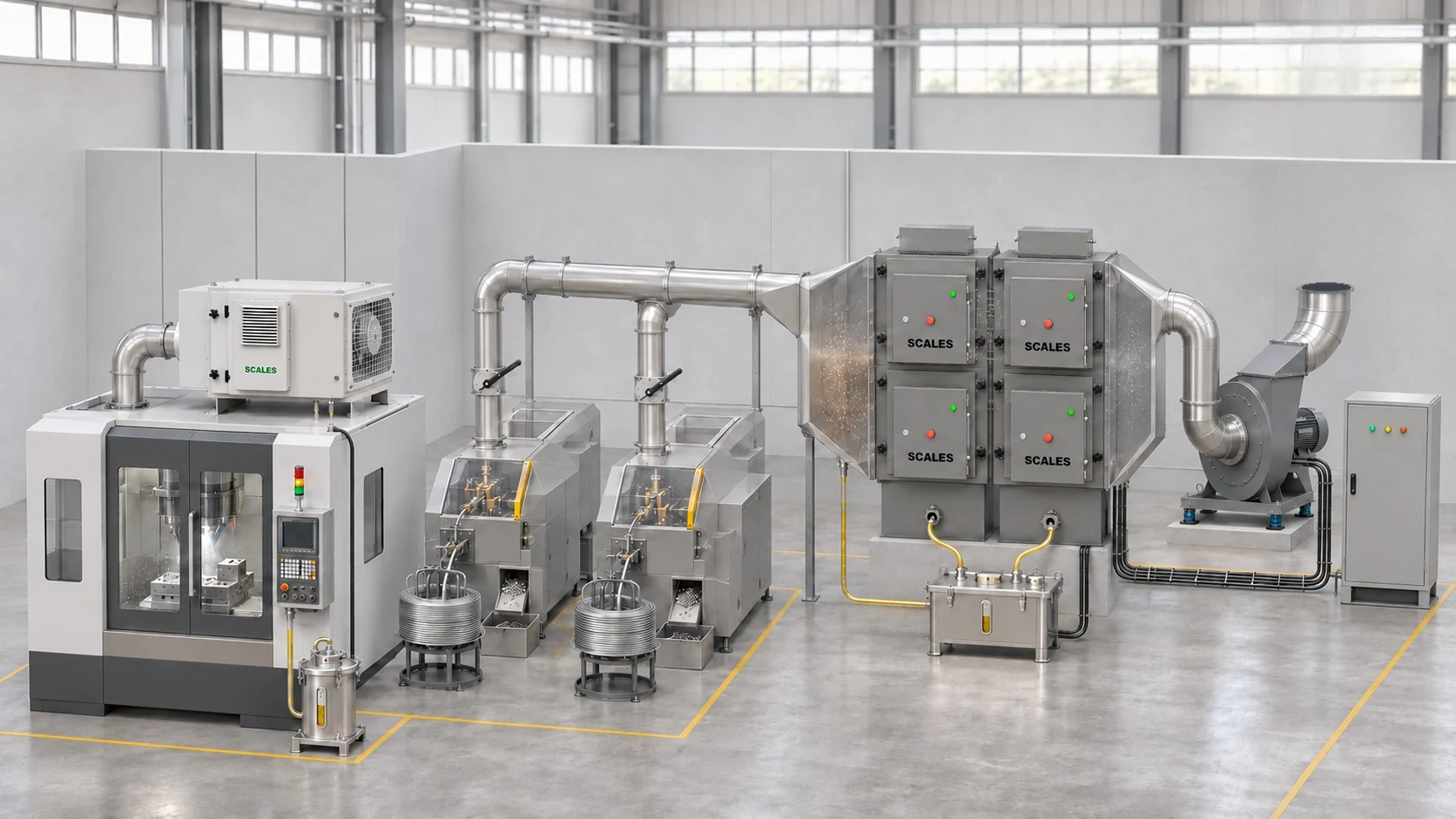
01
Two sources
- Machining mist
- Coolant and lubricant are broken into droplets by fast-spinning tools and parts and escape when the door opens. Emulsion mist is mostly water; neat-oil mist is mostly oil.
- Hot-process smoke
- When hot parts enter a quench tank or lubricant meets a hot die, oil evaporates and condenses into finer, stickier particles that quickly blind ordinary media.
02
Choosing equipment
| Duty | Series | Features |
|---|---|---|
| Single machine, mounted at the machine | SPM point-of-source oil mist collector | Fits on the machine with a small footprint |
| One or a few machines with heavy mist | SEA integrated electrostatic collector | Electrostatic collection with washable cells |
| Central system for many machines | SEM electrostatic oil mist collector | Modular, 2,500–50,000 m³/h at about 100 Pa |
| Emulsion mist and heavy mist | SOM multi-stage, SOS multi-stage separation and SOF modular collectors | Multi-stage mechanical separation and filtration |
| Higher final filtration | SOH high-efficiency oil mist filter | Multi-stage with a high-efficiency final stage |
| Quench, cold-heading and die-casting smoke | SEM or SEA; for hot, humid smoke, cool it first in an SVT scrubber | Electrostatic suits fine, sticky smoke |
03
Drainage and maintenance
- Oil collects at the base and drains to a container or back to the machine sump.
- Electrostatic cells are usually washed monthly, more often with heavy oil.
- Oil builds up in ducts; clean it regularly to prevent fires.
- Recovered oil can be reused, cutting coolant loss.
04
Odour and gases
Electrostatic and filter units remove the mist particles. Where odour or gases also need treating, an activated-carbon stage can be added.
05
Tell us when you enquire
- Machine types and number
- Oil-based or water-based coolant
- Whether machines are enclosed and how often doors open
- Available space and drainage needs
NEXT STEP