
TECHNICAL KNOWLEDGE
Where to Reduce Energy Use in Dust Extraction Systems
Most energy savings come from sealing leaks, clearing dust from ducts, giving each branch only the air it needs, slowing or stopping when production stops, and cleaning on pressure drop. Measure the saving under the same production conditions before and after.
Request a Technical Assessment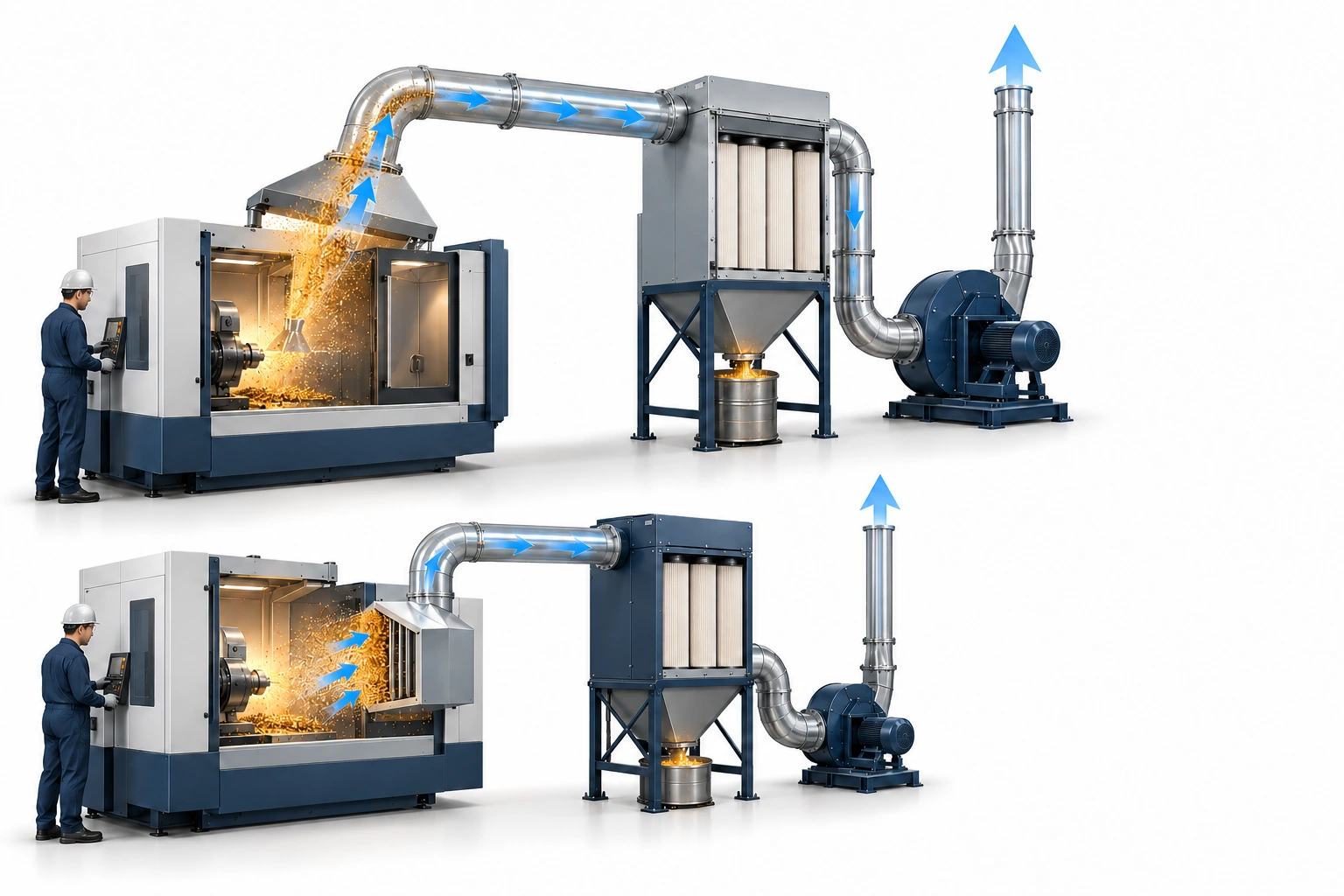
Where to save
- Leaks: air entering through doors, flanges and damaged ducts is extra work for the fan.
- Dust deposits: they narrow ducts and raise resistance.
- Idle stations: dampers left open. Fit automatic dampers linked to machine start and stop.
- Fan: add a VFD and run to actual demand.
- Cleaning: pulse on pressure drop to save compressed air and extend media life.
Calculating the saving
Under the same production conditions, measured fan input falls from 18 kW to 15 kW; at 4,000 hours a year, consumption falls from 72,000 kWh to 60,000 kWh, saving 12,000 kWh. At 0.80 yuan/kWh that is 9,600 yuan a year. Payback must also count the retrofit cost, consumables and maintenance.
Proving the result
Before the work, measure fan current or power, hood velocity and pressure drop in normal production; afterwards, measure the same points at the same output and stations. Only this comparison is convincing.