
TECHNICAL KNOWLEDGE
Selecting Duct Diameter and Air Velocity
With the duct airflow and chosen velocity, the diameter is D = √(4Q ÷ (3600 × π × v)). Too low a velocity lets dust settle in the duct; too high means more resistance, noise and wear.
Request a Technical Assessment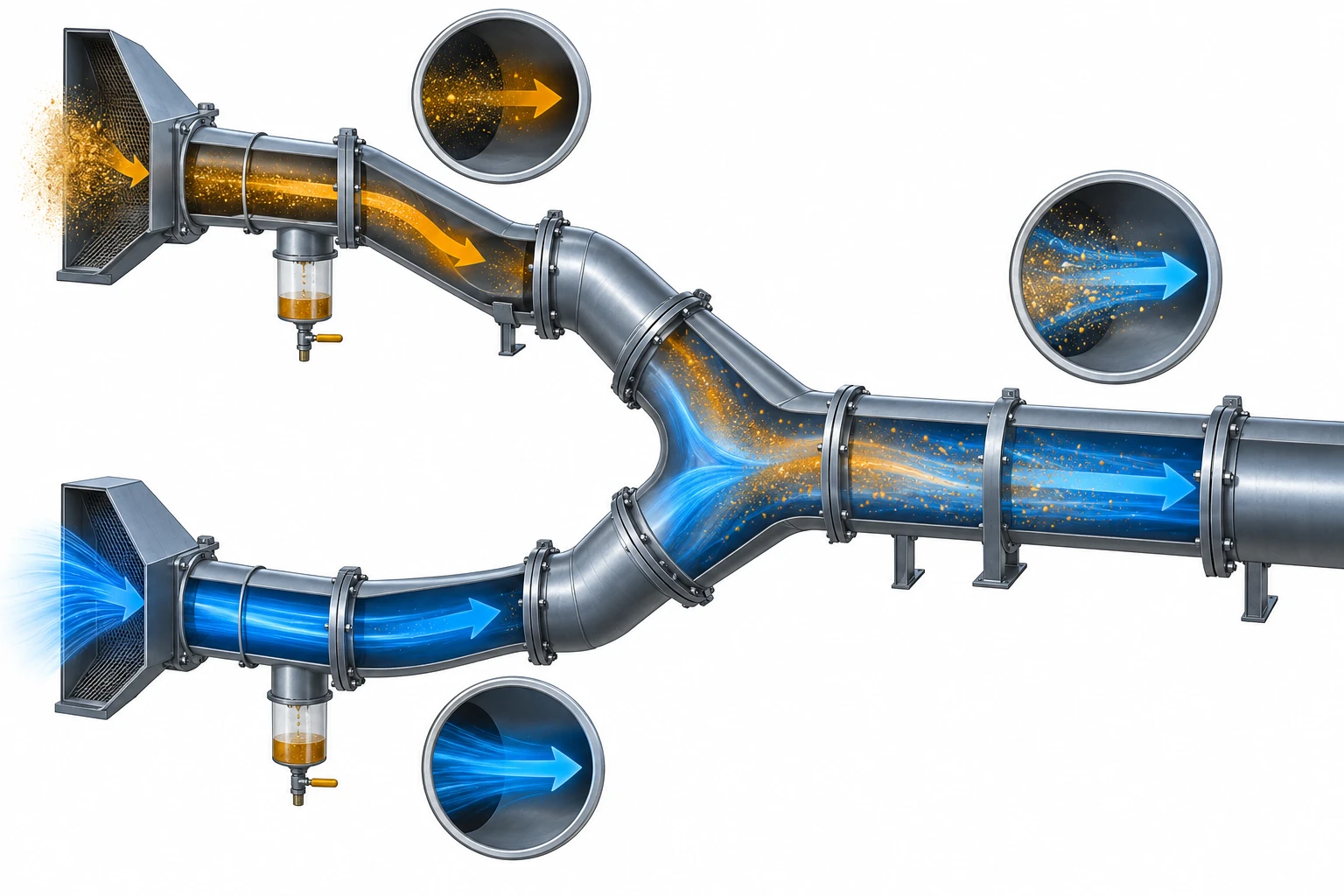
A worked example
A branch carrying 1,800 m³/h at 15 m/s needs D = √(4 × 1,800 ÷ (3600 × π × 15)) ≈ 0.206 m, about 206 mm. With a standard 200 mm duct, actual velocity = 4 × 1,800 ÷ (3600 × π × 0.200²) ≈ 15.9 m/s.
Choosing the velocity
- Heavier, coarser dust needs higher velocity to stay airborne.
- Fine fume and mist can run at lower velocity.
- For abrasive dust (blasting, foundry sand), avoid excessive velocity and use wear-resistant elbows.
- Round to a standard size, then recalculate velocity and resistance with the actual diameter.
Duct layout
Use long-radius elbows, join branches to the main at an angle rather than at right angles, and enlarge the main as branches join to keep velocity steady. Provide cleanout doors on horizontal runs.